

About Nikola Tesla
Engineering a Better World
“An inventor’s endeavor is essentially lifesaving. Whether he harnesses forces, improves devices, or provides new comforts and conveniences, he is adding to the safety of our existence.”
 Early Life and Family Background
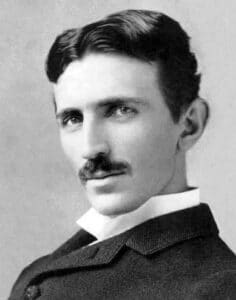
Nikola Tesla was born on a stormy night between July 9 and 10, 1856, in the small town of Smiljan, then part of the Austrian Empire. His birth is officially recorded as July 10. He was the third of four children in a gifted Serbian family steeped in education and faith. His father, like his maternal grandfather, was a Serbian Orthodox priest, and generations of men in the family had followed the same calling. His mother, while managing the household and garden, possessed a remarkable gift for invention, fashioning clever devices for domestic use. The children grew up memorizing poetry, exploring the family library, and learning to shape both imagination and intellect.
Though expected to follow his father into the priesthood, Tesla’s fascination with the mechanical world soon pulled him elsewhere.
Education and Early Fascination with Engineering
As a boy he built small contraptions, dreamed of faraway places, and often experienced visions so vivid they seemed almost real. After finishing secondary school at the Higher Real Gymnasium in Karlovac, Croatia, he persuaded his father to let him study engineering at the Austrian Polytechnic in Graz, Austria.
In 1875 Tesla entered university with extraordinary zeal, often working from dawn until late into the night. In a physics lecture he watched as a professor demonstrated a Gramme dynamo, its direct-current commutators spitting sparks. Tesla remarked that the commutators might be dispensed with entirely, by turning to what would later be known as alternating current. His professor dismissed the notion, but Tesla had already glimpsed the outline of a revolution.
At first his marks at school were flawless. But Tesla’s genius and enthusiasm wavered with fatigue, financial pressure, and his father’s concern. He left Graz to work briefly as a draftsman in Maribor, Slovenia. Years later, the records would confirm what his departure had already made clear—he had never graduated.
After his father’s unexpected death, Tesla returned home to comfort his mother, then set off for Prague, where his brief studies at Charles University also ended without a degree.
First Jobs and Breakthrough Inspiration
Tesla found work as an electrician at the Budapest Telephone Exchange, and in Budapest, while walking through a park in 1882, he first envisioned the rotating magnetic field that would become the basis for his AC induction motor. Not long after, while employed at the Continental Edison Company in Paris, Tesla began to see that the true stage for his ambitions lay across the Atlantic.
Arrival in American and a Break with Edison
In 1884, with little more than a few cents, some poems and sketches, and a mind filled with ideas, he boarded the SS City of Richmond for New York. He worked briefly for Thomas Edison, but their opposing goals and temperaments soon made collaboration impossible. Tesla struck out on his own.
Invention of the AC Induction Motor and the War of Currents
In the years that followed, he created the alternating current induction motor and developed a polyphase distribution system that would transform the world. In 1888, George Westinghouse recognized the value of Tesla’s inventions, purchased his patents, and brought him on as a consultant. Together they championed AC power against Edison’s direct current in the “War of Currents.” The conflict reached its dramatic peak at the 1893 World’s Columbian Exposition in Chicago, where Tesla’s system lit the fairgrounds in a blaze of electric light. The spectacle convinced the public, secured the future of AC, and laid the foundation for the electrical grid that still powers our lives.
Tesla’s Experiments and Cultural Impact in New York
Tesla’s genius, however, reached far beyond motors and power lines. He loved theater, art, and literature, and in New York he formed close friendships with writers, editors, artists, and actors. In his Manhattan laboratory he entertained friends and investors with dazzling experiments, and his demonstrations at Columbia College, the American Institute of Electrical Engineers, the New York Academy of Sciences, and universities abroad made him an international sensation. The Tesla coil, his signature invention, produced lightning-like arcs that thrilled his audiences.
Colorado Springs and Wireless Power Experiments
Still, he dreamed on a larger scale. In 1899 he moved to Colorado Springs, Colorado, believing its high altitude and clear mountain air ideal for his work. He built a laboratory with an eighty-foot wooden tower topped by a 142-foot mast and copper sphere, an instrument meant to harness the earth itself. Here he pursued the bold idea of transmitting power and information wirelessly across the globe.
Wardenclyffe Tower and the World Wireless Dream
Two years later he returned to New York, intent on building something even greater. With funding from financier J. P. Morgan, he began construction of the Wardenclyffe Tower on Long Island. It was to be the centerpiece of his World Wireless System, capable, he believed, of sending messages—and perhaps electricity—across oceans. But costs soared, Morgan withdrew, and the project collapsed. In 1917 the unfinished tower was dismantled for scrap, leaving Tesla discouraged but not defeated.
Later Work and New Inventions
Tesla pressed on with new ideas. He designed the bladeless Tesla turbine, promoted ozone-generating devices for health, and speculated about radar, radio-guided weapons, and a particle beam “death ray.” His interests broadened beyond science: he loved theater, delighted in the new silent films and “talkies,” and followed sports like boxing. Even in the turmoil of the First World War, he promoted tolerance and pacifism, and his ideas anticipated aspects of the modern environmental movement.
Final Years and Legacy
By the end of his life Tesla was not wealthy, but his ideas endured. He died in New York on January 7, 1943, at the age of 86, having left an indelible mark not only on technology but also on the cultural imagination of the Gilded Age. Although Wardenclyffe ended in failure, its ideas anticipated the age of wireless communication and even technologies like Wi-Fi. Fame and recognition for Nikola Tesla, though slow in coming, proved lasting. In 1960 the scientific community honored him by naming the SI unit of magnetic flux density the tesla. Since then, his name has become synonymous with invention and imagination.
Tesla’s story teaches us that imagination matters, that courage in pursuing new ideas can reshape the world, and that the boundaries of possibility are always wider than we think. He remains, as his mother once predicted, a child of light.